




Pomodoro breaks interrupt my focus: how to test a better rhythm
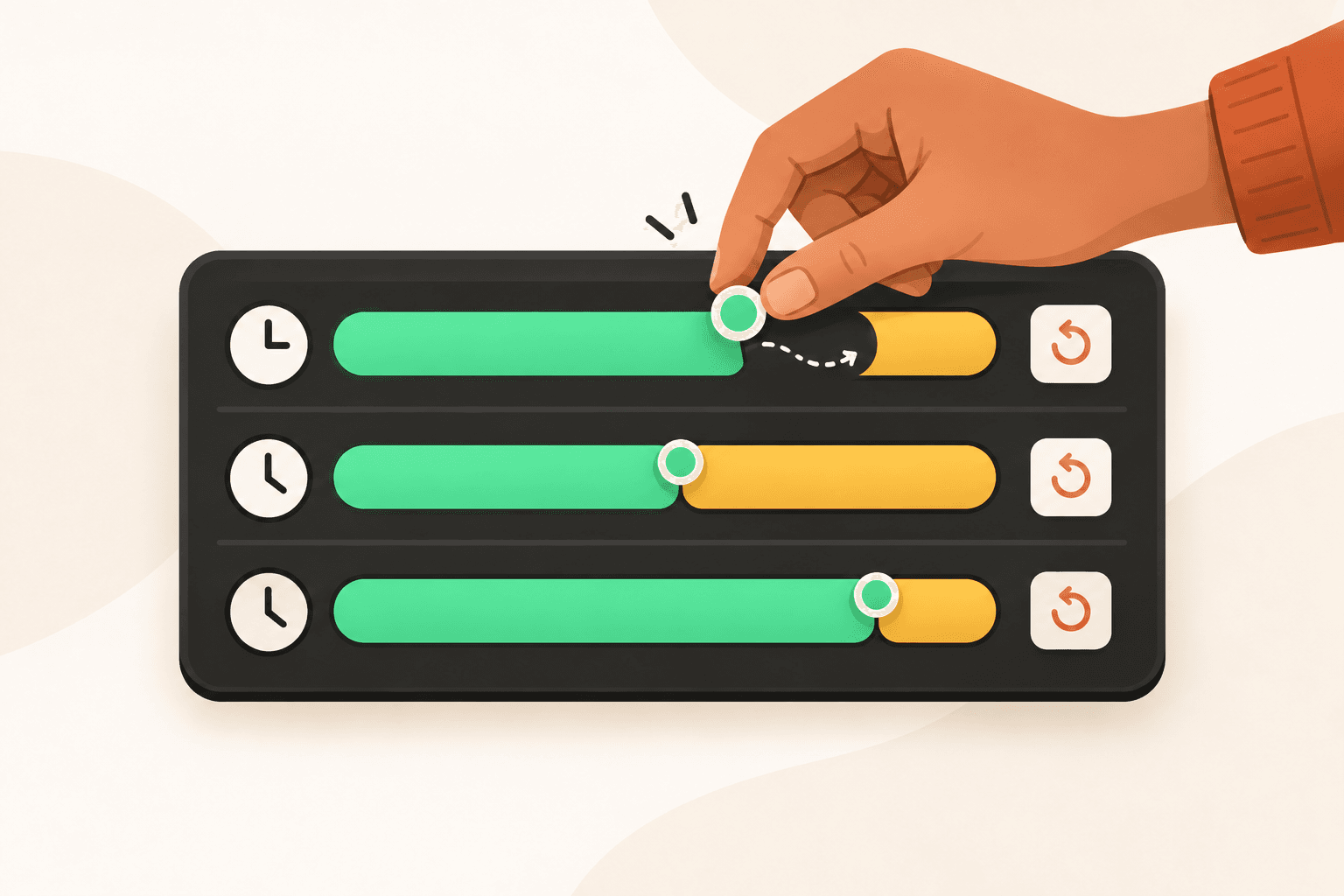
If 25/5 Pomodoro breaks interrupt your focus, compare a few fixed rhythms over five days and choose a timer that fits the work in front of you.
A timer rings just as a hard problem begins to make sense. You take the prescribed break, return, and spend ten minutes rebuilding the mental map you had a moment ago. That does not prove breaks are bad. It does mean 25 minutes and five minutes may be the wrong fixed rhythm for that task, on that day.
The useful question is not whether Pomodoro is good or bad. It is whether a particular cue helps you begin, gives you a needed pause, or cuts through work that is finally moving. A r/ProductivityApps discussion contains both reactions: several people say 25 minutes interrupts deeper work, while others use a timer to start avoided tasks or to remember to move. It is one conversation, not proof of prevalence. It is a reasonable prompt to run a small test instead of arguing with your own workday.
Why a scheduled break can feel like an interruption
Some work has a high restart cost. Debugging a tangled issue, writing a difficult argument, designing a system, or learning a dense topic often requires keeping several relationships in mind at once. If the alert arrives before you have written a stopping point, the break may be short but the return is not. The timer has changed the task from doing the work to reconstructing where you were.
Research on interruptions does not say that every pause ruins performance. A 2021 systematic review and meta-analysis of laboratory studies found that interventions intended to reduce interruption costs improved accuracy and reduced the time needed to resume the primary task. Effects differed by the type of intervention and the task. That supports a modest, practical idea: if you use a timer, make the handoff back to work easier. It does not validate any universal work-to-break ratio. See the review in Applied Ergonomics.
There is a second reason not to turn the timer off forever. Computer work can keep your hands, eyes, and body in one position for a long time. OSHA's computer-workstation guidance recommends brief pauses and task variation during long keyboard sessions. That is ergonomic guidance, not a promise that a five-minute alarm will improve concentration. See the OSHA computer-workstation guidance.
When breaks can help instead of splitting the work
A break can be useful when it arrives at a natural seam: after sending a draft, finishing a test run, closing a small batch of admin, or deciding the next move in a problem. It can also help when you are using the timer as a start ramp. Fifteen or 25 minutes may feel manageable when opening the task is the real obstacle. In those cases, the boundary gives the work a beginning and a contained first commitment.
A physical pause is a separate question from a focus claim. A 2026 meta-analysis of 21 randomized crossover trials found small associations between standing or activity breaks during prolonged sitting and executive function or memory, but it found no clear improvement for attention. The certainty was low or very low for most outcomes, and the authors warned against firm prescriptive rules. Use that result as permission to test a brief walk or stretch, not as evidence that 25/5 makes everybody sharper. Read the systematic review and meta-analysis.
Run a five-day fixed-rhythm test
This is an illustrative self-experiment, not medical advice or a clinical focus assessment. Keep the test deliberately plain. Compare like with like where you can: use it for a similar kind of work, at roughly the same time of day, and do not change your whole workstation routine at the same time. The goal is a usable decision, not a scientific finding about yourself.
- Day 1: use Pomodoro 25/5 for two or three work cycles on a task that normally needs concentration. Treat the end cue as a check-in. If you are in the middle of a fragile thought, take 30 seconds to make a restart note before the break.
- Day 2: use Deep Work 50/10 for comparable work. This is the better test for work that takes time to load into your head. Keep the break real: stand, look away from the screen, refill water, or walk a short distance. Do not begin an open-ended scroll.
- Day 3: use Sprint 15/3 on a task you have been avoiding, such as inbox triage, documentation cleanup, or a small administrative batch. Notice whether the short first commitment gets you moving or merely creates more clock-watching.
- Day 4: use 52/17 on a substantial, uninterrupted block if your calendar permits it. The longer interval is not a badge of discipline. It is simply another fixed comparison with a longer recovery period.
- Day 5: repeat the rhythm that looked most promising on the same kind of task as Day 1 or Day 2. A repeat matters more than a single unusually good afternoon. If no rhythm looks useful, record that result too.
For every session, write four short notes immediately after the break: the task, whether the timer arrived at a natural seam, how long it took to feel oriented again, and whether the break helped your body or attention. Keep the wording simple: 'returned immediately,' 'needed five minutes to reread,' or 'wanted the pause.' Do not score the session from app activity. Activity, keyboard use, and time at a computer are not scientific measures of focus, and a quiet minute may be thinking, reading, or a necessary pause.
Write the experiment as short notes
- 25/5: edit a proposal and stop mid-paragraph. Leave yourself the note, 'Next: compare the scope paragraph to the client brief.' If you need to reread the last section before writing, record that without calling the session a failure.
- 50/10: trace a bug and stop after isolating one suspect function. Leave the note, 'Next: test the null path in checkout.ts.' If you return with a clear first action, the longer break may have helped.
- 15/3: sort a support inbox and stop after a five-message batch. Leave the note, 'Next: reply to the billing question.' If several short breaks feel fussy, that is useful information too.
Protect the return, not just the break
The restart note is the small part that often decides whether a timer feels intrusive. Before you stand up, write one concrete next action and the thing you must remember. 'Investigate auth' is too vague. 'Open the failing login test; compare the token expiry in the fixture' gives your next self a handle. Leave the relevant file, document, or issue visible if that is safe for your workspace. Then take the break without trying to hold the whole problem in memory.
Make the break finite on purpose. A drink, a window, a few steps, or a brief stretch has a clear end. A news feed or a conversation that begins with 'just a minute' may be fine in your life, but it changes the experiment because it adds a second interruption. If you must answer something urgent, log it as an interruption rather than blaming the rhythm for the outcome.
Choose the rhythm by the result, not by the label
Keep 25/5 if it makes starting easier and you usually reach a clean pause before the alert. Choose 50/10 or 52/17 if demanding work takes longer to load and your notes show a quicker return after longer blocks. Keep 15/3 for short, resisted work if it gets you through the first step without leaving you more scattered. You can use different fixed rhythms for different kinds of work. Consistency within a task type is more useful than forcing every task into the same box.
A timer is probably too rigid when it repeatedly rings in the middle of meaningful progress, makes you watch the clock, or leaves you with a larger restart cost than the break repays. It may also be too loose when you keep postponing the first step or sit for long stretches without a pause you later wish you had taken. Neither result is a moral verdict. It is feedback about the cue and the work.
Use a timer as a visible experiment
If you want a fixed menu for this test, Flamely for Windows currently includes Pomodoro 25/5, Deep Work 50/10, Sprint 15/3, and 52/17, plus break reminders. Pick the preset that matches the day in your log, then keep a separate, honest note about how the return felt. Flamely can provide the timer and reminder. It does not offer adaptive timing, AI recommendations, a focus score, or proof that a particular schedule increased your productivity.